🚀 LEGO Star Wars Ultimate Buyer’s Guide
Comparing Iconic Sets from the Galaxy Far, Far Away
After spending countless hours building LEGO Star Wars sets over the past two decades—and probably enough money to buy an actual spaceship—I’ve learned something crucial: not all LEGO Star Wars sets are created equal. Some become instant classics that appreciate in value like fine wine, while others collect dust on clearance shelves faster than you can say “These aren’t the droids you’re looking for.”
The LEGO Star Wars theme celebrated its 25th anniversary in 2024, marking a quarter-century of bringing the galaxy far, far away into our living rooms, one brick at a time. What started with a handful of simple sets in 1999 has evolved into one of LEGO’s most lucrative and beloved themes, generating billions in revenue and spawning an entire collector community. This guide cuts through the marketing hype to help you make informed decisions about which sets deserve your hard-earned credits.
Featuring the Millennium Falcon, AT-AT, and other legendary vehicles
🏆 Understanding the Ultimate Collector Series (UCS)
Before we dive into specific sets, let’s talk about what makes UCS models the crown jewels of LEGO Star Wars. Launched in 2000, the Ultimate Collector Series represents LEGO’s commitment to creating museum-quality display pieces that push the boundaries of brick-building artistry. These aren’t toys for kids to crash into walls—they’re sophisticated builds designed for adult fans of LEGO (AFOLs) who appreciate engineering complexity and screen accuracy.
Think of UCS sets like haute couture in the fashion world. They’re expensive, meticulously crafted, and definitely not meant for everyday rough-and-tumble play. The typical UCS set features thousands of pieces, includes an information plaque for display, and achieves a level of detail that makes you wonder if the designers used electron microscopes to study the original movie props. When you complete a UCS build, you’re not just following instructions—you’re participating in an architectural meditation that can take anywhere from 15 to 40 hours.
🚀 The Heavyweight Champions: Premium UCS Sets
⚡ UCS Millennium Falcon 75192: The Undisputed Champion
Released: September 2017 | Pieces: 7,541 | Minifigures: 7
Let me be brutally honest: when this set arrived on my doorstep, I questioned my life choices. The box alone weighs over 30 pounds and is roughly the size of a microwave. My spouse gave me that look—you know the one—that says “where exactly do you think you’re going to put that thing?” Three weeks and approximately 25 hours of building later, I understood why this set commands such reverence in the LEGO community.
The 75192 Millennium Falcon isn’t just a LEGO set—it’s a engineering masterpiece that happens to be built from plastic bricks. What strikes you first is the sheer scale. At 33 inches long, this beast dwarfs every other LEGO Star Wars ship in your collection. But size alone doesn’t justify the premium price tag; it’s the obsessive attention to detail that makes this worthy of its “ultimate” designation.
The exterior features what LEGO designers call “greebling”—those hundreds of tiny mechanical details that make the surface look like a well-worn freighter that’s made the Kessel Run in less than twelve parsecs. Every panel, pipe, sensor dish, and exhaust port has been meticulously recreated. The build includes swappable parts that let you configure the Falcon to match either The Empire Strikes Back (with the circular radar dish) or The Force Awakens (with the rectangular one). It’s this kind of thoughtful design that separates UCS sets from their play-scale cousins.
7,541 pieces of pure Star Wars excellence
🦿 UCS AT-AT 75313: Imperial Power Personified
Released: November 2021 | Pieces: 6,785 | Minifigures: 9
If the Millennium Falcon is the flashy sports car of LEGO Star Wars, the AT-AT is the imposing military tank. Standing 24.5 inches tall and stretching 27 inches long, this Imperial walker commands attention in ways that few LEGO sets can match. When I first saw this displayed at my local LEGO store, it legitimately stopped me in my tracks. The sense of scale and presence is simply stunning.
What makes the AT-AT particularly impressive is how the designers solved the stability challenge. Anyone who’s built LEGO walkers knows they tend to be top-heavy and prone to catastrophic collapse if you so much as sneeze nearby. The 75313 addresses this through a brilliant internal Technic frame that distributes weight across three layered structures. The result? A walker that’s actually surprisingly stable, despite its imposing height and relatively narrow stance.
The interior is where this set truly shines. Previous AT-AT models offered token interior spaces—maybe a few seats and some stickers pretending to be control panels. This UCS version goes all-in with a fully realized troop compartment featuring forty individual seats arranged across two decks, just like the canonical specifications describe. Opening the massive side panels feels like revealing a cross-section from a Star Wars technical manual. The attention to detail extends to the cockpit, which seats two AT-AT drivers with room for a third figure, complete with working controls and viewing ports.
Since retiring in December 2024, this set has already begun appreciating in value on the secondary market, with sealed boxes fetching $900-$1,200. That’s a relatively modest 7% increase, but given the AT-AT’s iconic status and the quality of this particular model, I expect prices to climb steadily over the next few years.
📊 Head-to-Head Comparison
| Feature | UCS Millennium Falcon 75192 | UCS AT-AT 75313 |
|---|---|---|
| Piece Count | 7,541 pieces | 6,785 pieces |
| Price (MSRP) | $849.99 | $849.99 (Retired) |
| Dimensions | 33″ L × 22″ W × 8″ H | 27″ L × 9.5″ W × 24.5″ H |
| Build Time | 20-40 hours | 15-25 hours |
| Minifigures | 7 (dual crews) | 9 (Imperial forces) |
| Display Value | Horizontal dominance | Vertical impact |
| Interior Detail | Moderate (limited space) | Exceptional (40 seats!) |
| Stability | Excellent (flat base) | Good (with careful posing) |
| Availability | Currently in stock | Retired (secondary market) |
| Investment Potential | Proven long-term value | Rising (7% since retirement) |
🎯 2025 Sets Worth Your Attention
While UCS sets grab headlines, LEGO continuously releases excellent mid-tier options that offer tremendous value without requiring a second mortgage. The 2025 lineup demonstrates LEGO’s commitment to serving collectors at multiple price points, with several sets that I’m genuinely excited about.
🛸 New Releases to Watch
- ARC-170 Starfighter (75402) – $69.99: This marks the first minifigure-scale ARC-170 since 2010, and it’s arriving just in time for Revenge of the Sith’s 20th anniversary. At 497 pieces with four minifigures (including Odd Ball and Captain Jag), this represents exceptional value. The Clone Wars era consistently produces some of the most visually interesting vehicles, and the ARC-170’s aggressive profile should make for a striking display piece.
- Buildable Grogu with Pram (75403) – $99.99: Following the success of the R2-D2 buildable figure, LEGO is giving Baby Yoda the same treatment. At 1,048 pieces, this large-scale figure includes the iconic hover pram and multiple accessories (blue cookies, alien frog, and the control knob). It’s positioned perfectly for Mandalorian fans who want something displayable without committing to a full UCS price tag.
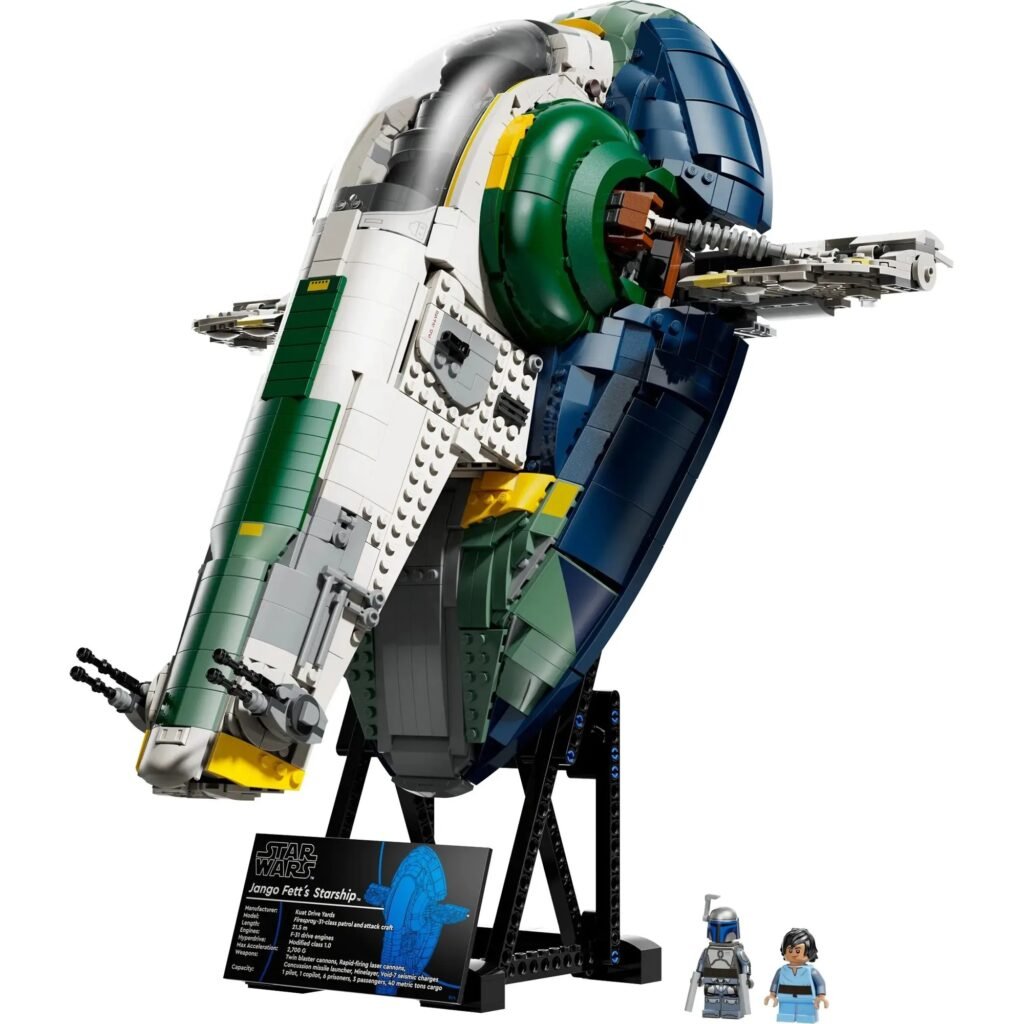
- Jango Fett’s Starship UCS (75409) – $299.99: The Firespray-class patrol craft (formerly known as Slave I before Disney’s name change) gets the UCS treatment with 2,970 pieces. What’s particularly interesting here is the dual display option—you can show it in landing position or mounted vertically in flight configuration. The inclusion of Jango and young Boba minifigures with enhanced printing makes this especially appealing to prequel trilogy fans.
Featuring ARC-170, Grogu, and Jango Fett’s Starship
✅ Advantages & Drawbacks Analysis
✨ Key Advantages
- Investment Value: Retired UCS sets historically appreciate 100-400% over 5-10 years, outperforming many traditional investments
- Therapeutic Building: Complex builds provide genuine stress relief through focused, meditative construction (backed by psychological research)
- Engineering Education: Advanced Technic integration teaches mechanical principles and spatial reasoning
- Display Impact: UCS models command attention and serve as conversation pieces that reflect personal interests
- Cross-Generational Appeal: Star Wars nostalgia spans generations, making these sets meaningful to builders from 18 to 80
- Modular Display Options: Many sets offer multiple configuration options (swappable parts, different poses)
⚠️ Important Considerations
- Space Requirements: UCS sets demand significant display real estate—often 2-3 square feet minimum
- Financial Commitment: Premium sets cost $300-$850, requiring serious budgeting for most collectors
- Dust Management: Intricate exterior details trap dust like a Tatooine sandstorm; regular maintenance essential
- Limited Playability: These are display models first; fragile details make them unsuitable for children under 16
- Market Volatility: Not every set appreciates; some stagnate or decrease in value based on overproduction
- Assembly Commitment: Major builds require 15-40 hours; starting a UCS set you won’t finish creates expensive clutter
💡 Expert Building & Display Tips
🔧 Construction Best Practices
Having built over 30 LEGO Star Wars sets ranging from $30 battle packs to the massive UCS Falcon, I’ve developed some hard-learned techniques that significantly improve the building experience:
- Create a Dedicated Build Space: Attempting to build a 7,000-piece set on your coffee table while watching TV is a recipe for lost pieces and frustration. Clear a large table or workspace where bags can stay organized for days or weeks at a time. I use a 4′ × 6′ folding table in my home office that becomes “LEGO central” during major builds.
- Invest in Parts Organization: Those 40+ numbered bags are great, but once you open a bag containing 300 tiny pieces, chaos ensues quickly. I use flat sorting trays (like those designed for beading or hardware) to separate pieces by color and size within each bag. This seemingly simple step cuts build time by 20-30% by eliminating the constant “where’s that specific 1×2 plate” searches.
- Take Breaks Strategically: UCS builds involve repetitive steps—building four identical leg assemblies, attaching dozens of greeble details, etc. When you feel your enthusiasm waning, that’s the time to stop. Coming back fresh transforms tedious steps into enjoyable progress. I typically build in 2-3 hour sessions, usually after work when I want to decompress.
- Document the Journey: Photograph your build progress, especially the internal framework before it gets covered. These photos become surprisingly meaningful later, and they’re invaluable if you ever need to disassemble for moving or repairs. Plus, time-lapse build videos are hugely popular on social media if that’s your thing.
- Follow Instructions Precisely: I know it’s tempting to “freestyle” certain sections or skip ahead, but UCS sets have extremely precise engineering tolerances. That weird sub-assembly that seems pointless? It’s probably providing crucial structural support you’ll appreciate later. Trust the designers—they’ve spent months perfecting these builds.
🖼️ Display and Preservation
Spending hundreds of dollars and dozens of hours building a masterpiece only to watch it slowly deteriorate from dust and gravity is heartbreaking. Here’s how to keep your UCS sets looking showroom-fresh for years:
- Lighting Matters More Than You Think: Strategic LED lighting transforms a good display into a spectacular one. I use adjustable LED strips with warm white tones (2700-3000K) positioned to highlight key features without creating harsh shadows. The Millennium Falcon particularly benefits from backlighting that makes the engines glow. Avoid direct sunlight, which yellows white and light gray bricks over time.
- Structural Support Systems: Large sets like the Falcon need support beyond their own landing gear. I built a custom display base using black-painted MDF that provides stable support and creates a “floating” illusion. For the AT-AT, I reinforced the leg joints with clear acrylic supports that are virtually invisible but prevent the slow “spread” that can occur from prolonged display.
- The Dust Problem: Compressed air is your friend, but use it carefully—too much pressure can dislodge pieces. I dust my UCS sets monthly using a soft paintbrush followed by gentle bursts of compressed air. For stubborn dust in tight areas, photographer’s lens cleaning tools work brilliantly. Some collectors use museum-grade display cases, which eliminate dust entirely but cost $200-$500.
- Earthquake/Pet Protection: If you live in seismically active areas or have curious cats, museum putty (the removable, non-staining kind) under the feet/base prevents disaster. I learned this after my cat decided the AT-AT was an excellent climbing challenge. Two strategically placed putty dots have prevented repeats of that $850 heart attack.
❓ Frequently Asked Questions
🤔 Which set should I buy first?
This depends entirely on your budget, available space, and Star Wars preferences. If you’re new to UCS sets and want to test the waters, I’d recommend starting with something in the $200-$400 range rather than diving straight into the $850 Falcon. The upcoming Jango Fett’s Starship at $299.99 represents an excellent middle ground—complex enough to feel substantial, but not so overwhelming that you’ll abandon it halfway through.
From a pure value perspective, currently-available sets always make more financial sense than chasing retired sets on the secondary market. Yes, the AT-AT is spectacular, but paying $1,000+ for what was originally an $850 set only makes sense if you’re absolutely certain you’ll never be satisfied without it.
💰 Are LEGO Star Wars sets good investments?
Here’s the honest truth: treating LEGO as a pure investment strategy is complicated. Yes, some sets have appreciated spectacularly—the original UCS Millennium Falcon being the prime example. However, this requires buying multiple sealed copies, storing them properly for years, and hoping LEGO doesn’t re-release similar versions that tank your investment.
The 75192 Falcon illustrates this perfectly. The original 10179 from 2007 was commanding $3,000-$5,000 before the 75192 release in 2017. Then boom—anyone could buy a new, improved version for $800, and the old one’s value dropped to $1,500-$2,000. It has since recovered somewhat, but that dramatic crash ruined many “investment” strategies.
Buy LEGO Star Wars sets because you love building and displaying them. If they appreciate, consider that a happy bonus rather than the primary motivation. The real ROI is the hours of enjoyment and the display piece that makes you smile every time you see it.
🧒 Can kids build these sets?
UCS sets are explicitly designed for ages 18+, and that rating exists for good reason. The Falcon includes over 1,300 building steps with pieces as small as 1×1 plates and tiles. The instructions assume builder familiarity with advanced LEGO techniques and don’t hold your hand through complex sub-assemblies.
That said, I’ve seen talented 12-14 year olds successfully complete UCS builds with parental guidance. The key factors are patience, fine motor skills, and attention to detail. If your child zooms through regular LEGO sets and expresses genuine interest, a supervised UCS build can be an incredible bonding experience. Just be prepared to help problem-solve tricky sections and maintain organization.
For