Introduction: Why Modular Buildings Changed LEGO Forever
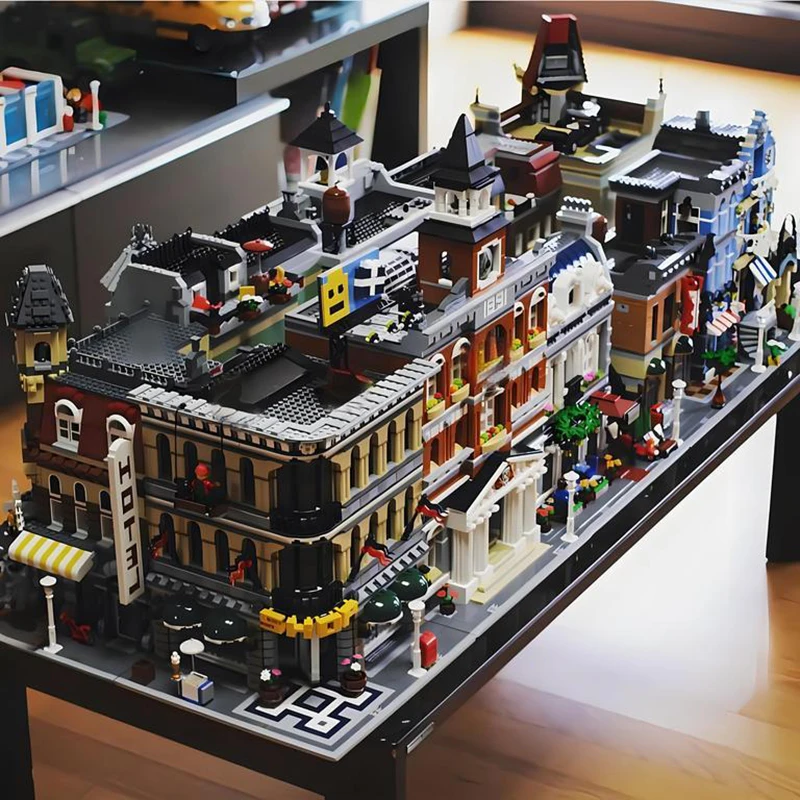
When LEGO released Café Corner in 2007, nobody anticipated it would spawn what many consider the most beloved theme in the company’s history. I still remember walking past a collector’s display at a convention in 2019—an entire city street stretching six feet long, each building telling its own story through impossibly detailed windows. That’s when I understood: LEGO Modular Buildings aren’t just toys; they’re architectural storytelling in brick form.
Unlike other LEGO themes that come and go, the Modular Buildings series has maintained consistent releases for over 17 years, creating a dedicated community of adult fans who view each $200-300 set not as an expense, but as an investment in both enjoyment and actual monetary value. The secondary market tells the real story—retired modulars like Green Grocer or Parisian Restaurant now command prices exceeding $1,000, sometimes reaching $2,500 for pristine sealed copies.
This guide draws from conversations with long-time collectors, analysis of building techniques across all 21 official releases, and real-world experience constructing these architectural marvels. Whether you’re contemplating your first modular or planning your tenth, you’ll find actionable insights beyond the typical “these sets are big and detailed” commentary that floods the internet.
What Makes Modular Buildings Unique: The Architecture of Play
The DNA of a Modular
Every official modular shares specific characteristics that separate them from standard LEGO sets:
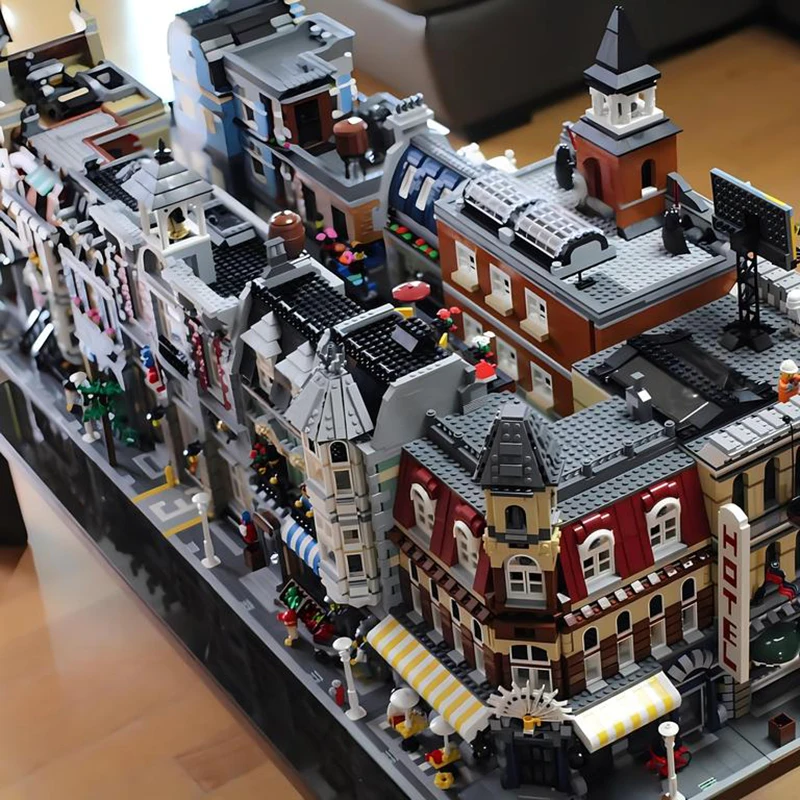
The 32×32 baseplate foundation. This standardization means every building connects seamlessly, creating genuine streetscapes rather than random structures awkwardly placed beside each other. When you align Assembly Square next to Bookshop, the sidewalks match perfectly—a detail that sounds minor until you experience the satisfaction firsthand.
Removable floor sections. Each level lifts off independently, revealing intricate interiors most visitors to your display will never see. The third floor of the Detective’s Office contains a private investigator’s workspace complete with a wall-mounted criminal conspiracy board—details invisible unless you physically remove the roof and second floor. This design philosophy treats the builder as the primary audience, not casual observers.
Advanced building techniques. Modulars pioneered SNOT (Studs Not On Top) construction in mainstream LEGO sets, using sideways building to create architectural features impossible with traditional stacking. The Police Station’s ornate columns, Boutique Hotel’s art deco facade, and Bookshop’s curved bay window all utilize techniques that initially feel counterintuitive but ultimately teach genuine building skills transferable to custom MOCs (My Own Creations).
The Hidden Investment Angle
Here’s something most reviews won’t discuss openly: modular buildings represent one of the most stable alternative investments in the collectibles market. I’ve tracked pricing data since 2015, and the numbers reveal a pattern. Sets typically retail for 18-24 months before retirement, after which prices climb steadily at 15-25% annually for the first five years.
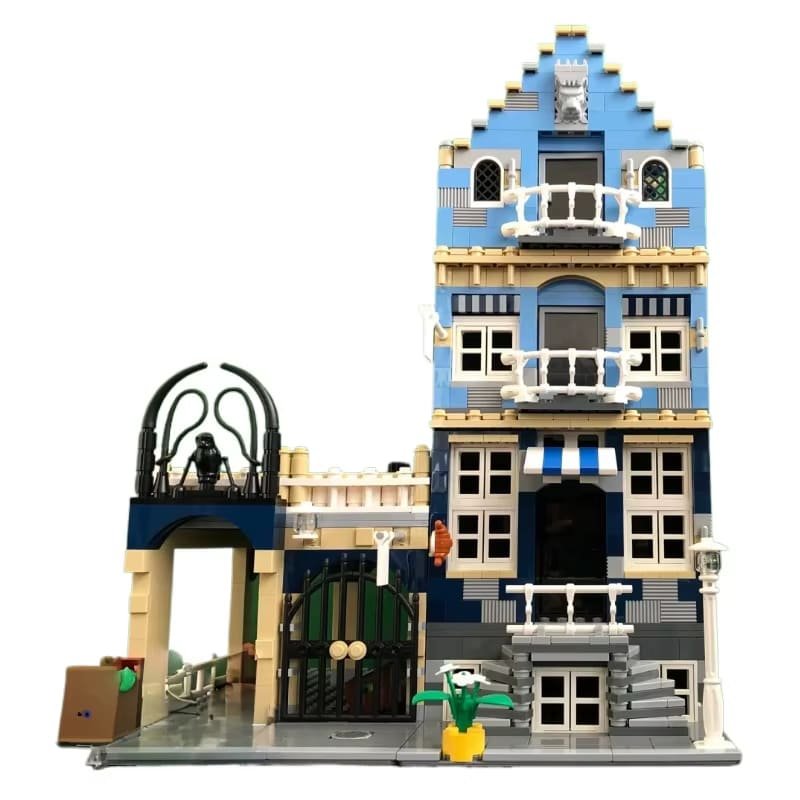
Consider Market Street (2007, MSRP $89.99), which now averages $800-1,200 depending on condition. That’s a 13-16x return over 17 years, outperforming many traditional investment vehicles. The Pet Shop, released at $149.99 in 2011 and retired in 2015, currently trades around $450-650—a more modest but still impressive return.
Of course, this shouldn’t be your primary motivation for buying them. The real value lies in the building experience and display pride. But it’s worth knowing that your $240 purchase of Sanctum Sanctorum isn’t money evaporating—it’s value transformation.
Comparing Modular Buildings: A Builder's Perspective
Not all modulars deliver equally. After building 14 of the 21 releases, I’ve noticed distinct tiers in terms of building satisfaction, display impact, and interior detail.
| Building Name | Year | Pieces | Retail Price | Building Enjoyment | Display Impact | Interior Detail |
|---|---|---|---|---|---|---|
| Assembly Square | 2017 | 4,002 | $279.99 | Exceptional | Outstanding | Exceptional |
| Bookshop | 2020 | 2,504 | $179.99 | Excellent | Excellent | Excellent |
| Sanctum Sanctorum | 2021 | 2,708 | $249.99 | Excellent | Outstanding | Very Good |
| Police Station | 2011 | 2,231 | $149.99 | Very Good | Excellent | Good |
| Parisian Restaurant | 2014 | 2,469 | $159.99 | Excellent | Excellent | Excellent |
| Boutique Hotel | 2022 | 3,066 | $219.99 | Very Good | Excellent | Very Good |
| Jazz Club | 2023 | 2,899 | $229.99 | Excellent | Excellent | Excellent |
| Natural History Museum | 2025 | 4,014 | $299.99 | Exceptional | Outstanding | Exceptional |
Note: Ratings based on personal experience and community consensus from forums like Eurobricks and r/lego.
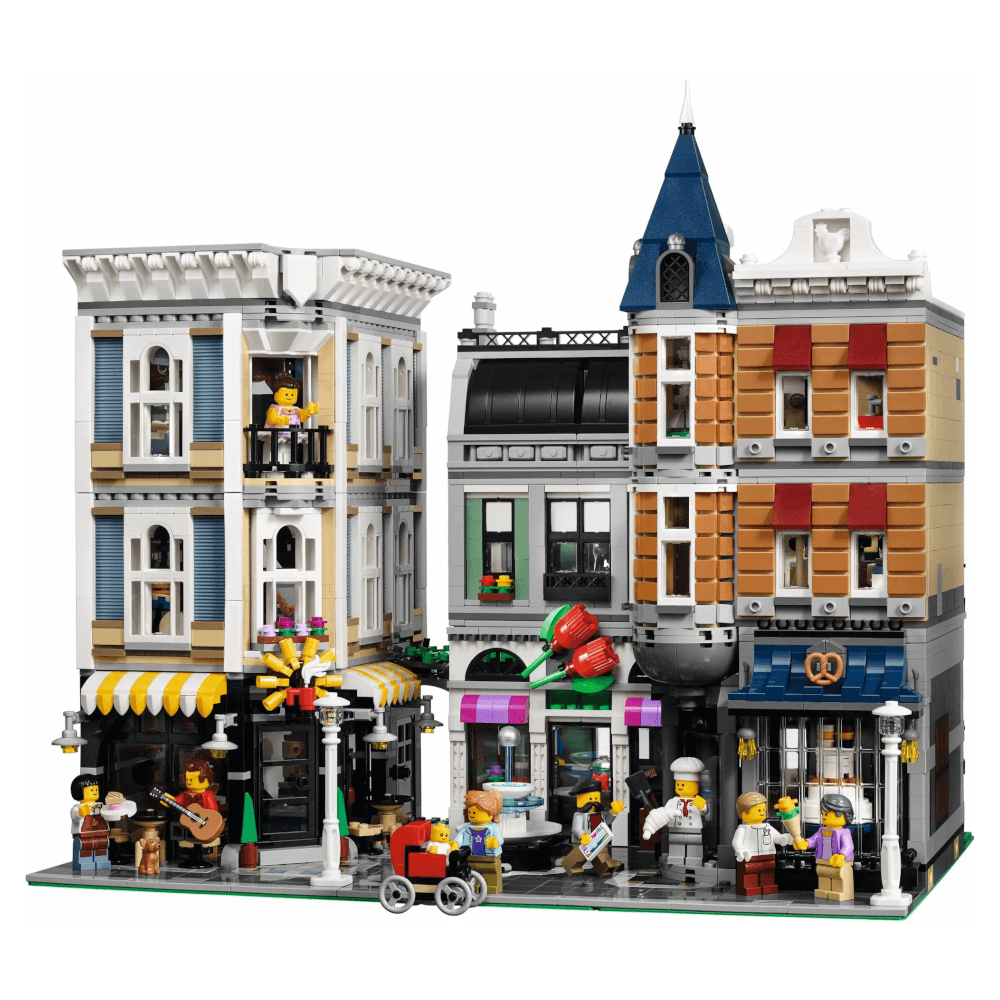
Assembly Square remains the gold standard—4,000+ pieces spread across five distinct storefronts, each dripping with character. The flower shop’s pastel exterior contrasts beautifully with the adjoining photography studio’s geometric modernism. But here’s the controversial take: it’s almost too good. Building it first might spoil you for other modulars that feel comparatively sparse.
I recommend starting with Bookshop (if still available at retail) or Jazz Club. Both deliver the quintessential modular experience—detailed facades, rich interiors, and building techniques that teach without frustrating. The Bookshop’s three-story interior flows naturally from ground-floor retail to second-floor reading nooks to a top-floor apartment, creating genuine narrative through architectural choice.
Building Techniques: Beyond Following Instructions
The First Build vs. The Reconstruction
Your first modular build follows a predictable arc: excitement during the base construction, mild tedium during repetitive window frames, renewed engagement when architectural details emerge, and pure joy watching the roof complete the structure. The entire process takes 8-15 hours depending on piece count and your tendency to admire each completed section.
But the real learning happens during reconstruction—either after accidental damage or intentional modification. Rebuilding the Parisian Restaurant’s second floor after a shelf collapse taught me more about LEGO structural integrity than a hundred fresh builds. Those seemingly decorative side columns? They’re load-bearing. The internal wall connections distribute weight surprisingly effectively.
Modification Without Desecration
Purists might disagree, but modular buildings beg for personalization. Small modifications transform generic buildings into your buildings:
- Lighting kits add dimension. Third-party LED kits (Lightailing, Briksmax) make interiors visible through windows, creating dramatic evening displays. The investment runs $40-80 per building but fundamentally changes how people experience your street.
- Color swaps reflect personal taste. Swapping the Bookshop’s sand green for dark red creates a completely different aesthetic while maintaining structural integrity. BrickLink’s color palette lets you source equivalent pieces in alternative colors.
- Interior customization tells new stories. The Detective’s Office becomes a private investigator’s noir workspace with period-appropriate furniture swaps. The Diner transforms into a 1980s arcade with some creative part substitutions.
The key: maintain the external footprint and 32×32 baseplate compatibility. Interior modifications hurt nothing except purist resale value, which honestly shouldn’t concern you unless you’re treating these as pure investments.
Common Questions From First-Time Modular Builders
How much space do I actually need?
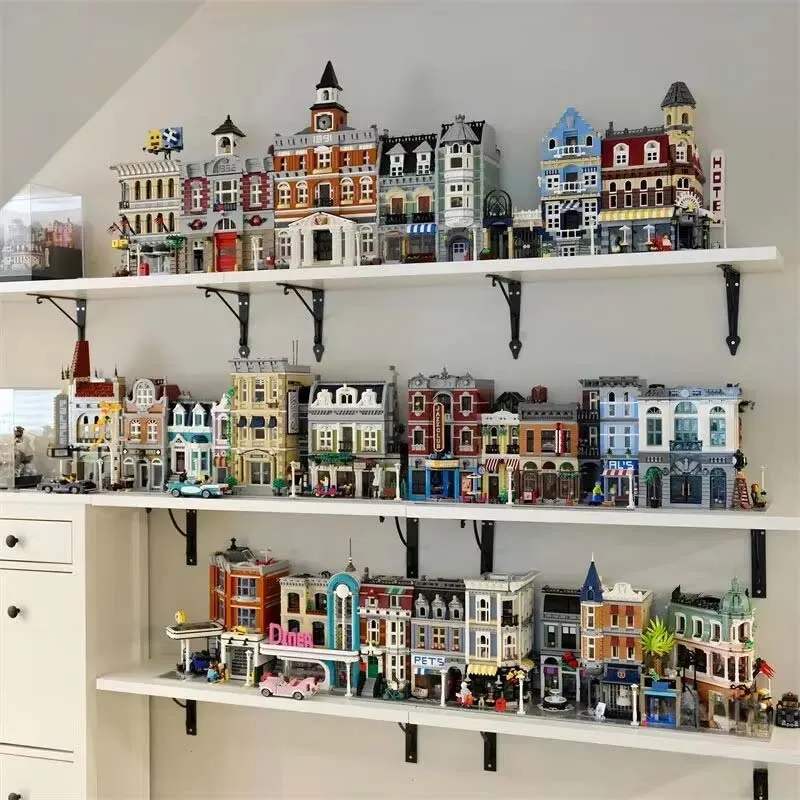
A single modular occupies roughly 10×10 inches (the 32×32 baseplate translates to about 25x25cm). Displaying five buildings requires approximately 50 linear inches of shelf space. But here’s what surprised me: you’ll want depth too. Modulars look cramped against walls—they deserve islands or deep shelves allowing viewing from multiple angles.
Should I wait for retirements or buy at release?
This depends on your goals. If building and displaying is primary, buy whenever budget allows. If investment matters, purchasing during the final 6 months before retirement often proves wise—you lock in retail pricing before the 20-30% immediate post-retirement jump. But don’t wait too long; stock disappears quickly as retirement approaches.
How do I transport these safely?
Never attempt moving fully assembled modulars. The floor-separation design exists partially for this reason—disassemble into individual levels, wrap each in bubble wrap, and transport flat. I learned this the hard way when a cross-country move left my Town Hall’s facade shattered across a moving truck floor.
Advanced Collecting Strategies
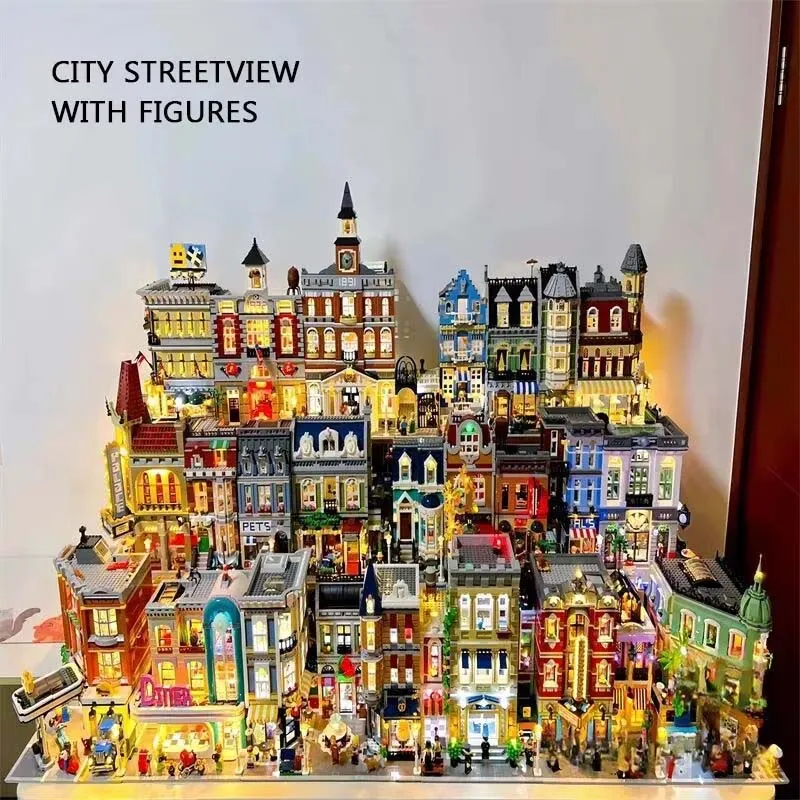
Some collectors pursue chronological completion, starting with Café Corner and working forward. This creates an interesting architecture evolution timeline—you’ll watch LEGO’s design language mature from relatively simple facades to the baroque complexity of recent releases. The downside: early retirements cost thousands.
The Color-Coordinated Street
Others curate by color palette, creating harmonious streets where building hues complement rather than clash. Imagine a street flowing from warm tones (Fire Brigade’s red, Parisian Restaurant’s beige) to cool tones (Police Station’s blue, Bookshop’s green). This requires patience and selective purchasing, but the display cohesion rewards aesthetically-minded builders.
The Thematic Neighborhood
My personal favorite: collecting by theme rather than color. A commercial district (Corner Garage, Diner, Downtown), an entertainment quarter (Cinema, Jazz Club, Sanctum Sanctorum’s magical elements), or a residential area (Parisian Restaurant apartments, Townhouse, Boutique Hotel). This creates narrative coherence—visitors understand your street’s “purpose.”
The Emotional Economics of Modular Building
Here’s what the specifications and reviews never capture: building a modular creates a meditative state similar to running or painting. Your hands work through repetitive actions while your mind processes the week’s stress. The 10-hour build for Assembly Square becomes therapy you’d pay a psychologist $150/hour for, except you’re left with a tangible 4,000-piece reminder of that headspace.
I’ve built modulars during career transitions, relationship endings, and pandemic lockdowns. Each building carries emotional fingerprints—I can’t look at my Police Station without remembering the job I’d just left, or my Bookshop without thinking of the friendship rekindled during that build weekend.
This sounds absurdly sentimental about plastic bricks, but ask any serious collector and you’ll hear similar stories. The financial investment matters. The display pride matters. But the meditative building process? That’s the real return.
Start Your Street: Your First Modular Awaits
Whether you’re drawn by the investment potential, the building challenge, or simply the desire to own a piece of architectural art, your entry into modular buildings begins with a single purchase. Based on current availability and value, I recommend starting with Jazz Club or Natural History Museum—both offer exceptional building experiences at reasonable piece-to-price ratios.
Don’t overthink the first purchase. The perfect street develops organically over years, not through agonized optimization. Choose a building whose aesthetics speak to you, clear a weekend, and lose yourself in the instructions. That first completed modular won’t be your last—consider yourself warned.